
Socialism = Fascism
"Captive Nations" is why we don't have health care

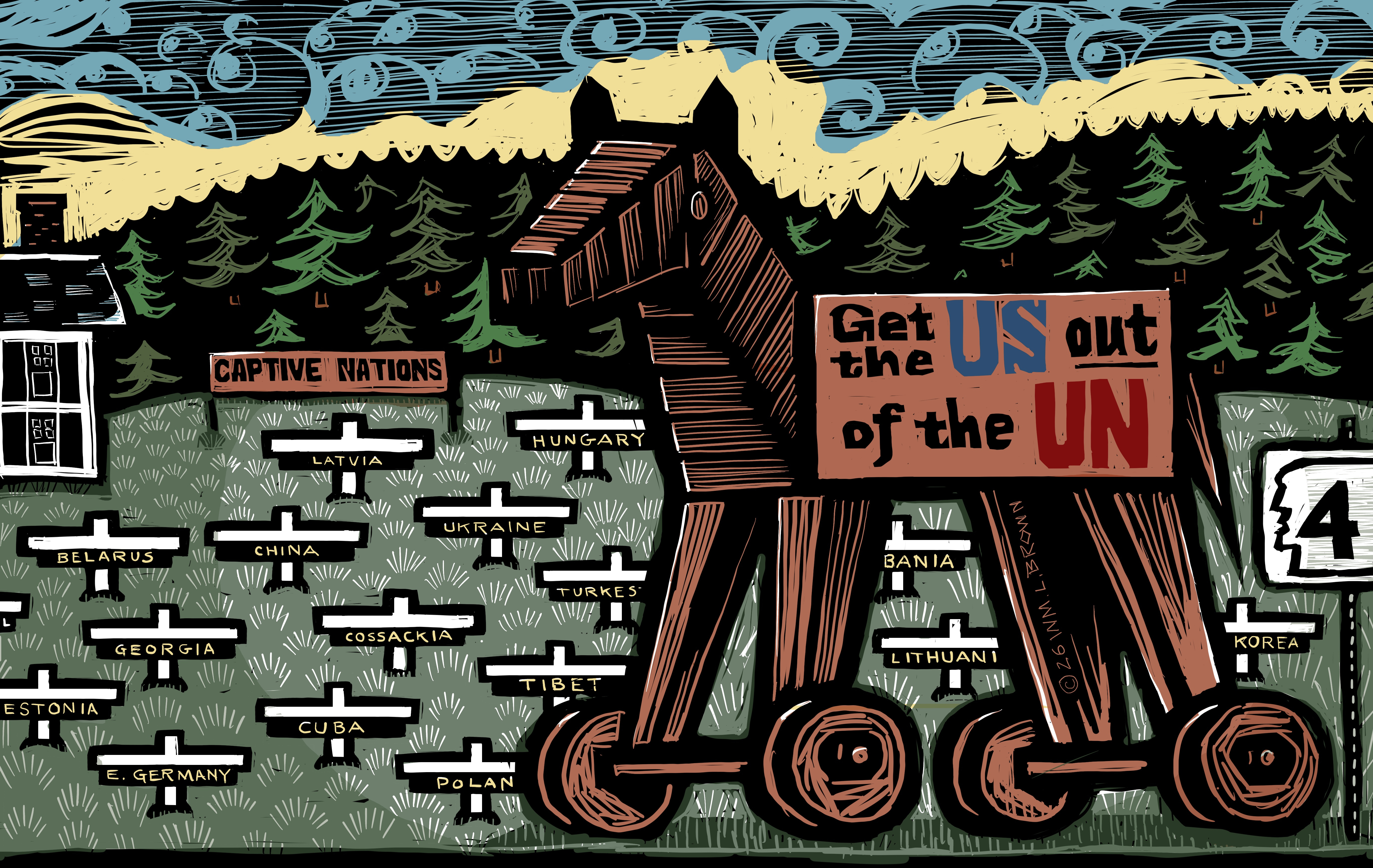
Captive Nations/Trojan Horse, ©2026, William L. Brown.
This is Captive Nations Week, as first decreed in 1959.
The Captive Nations display was a road-side feature on Route 4 in Epson, NH. It was built around 1959-60, as the McCarthy era, a period of rigid conformity and right-wing paranoia, gave way to the Kennedy era, a period of relative modernity and liberalism.
The Captive Nations display was homemade, hokey and a metaphorical mishmash: captivity, graves and the Trojan Horse. Small crosses, each named for a nation under socialist domination, were laid out next to a twelve-foot tall Trojan horse on wooden wheels. A placard on the horse read “The the US out of the UN.”
The mock graveyard and horse, located on the grounds of the Sherwood Inn, a hotel associated with the reactionary John Birch Society, was not so much a memorial to people suffering under socialist dictatorship, it was a prop for the anti-UN message.
This sort of right-wing fear-mongering about socialism is why we don’t have decent health care in the US.
They redefine as “socialism” everything they don’t like: taxes, public parks, libraries, schools, aid to the poor and disadvantaged, public transportation and universal health care. None of these are socialism.
Socialism is a 19th-century political-economic ideology that proposes solving all problems through government control of the economy. It was invented by males, so of course, it fails to take into account human nature and other realities.
Social programs and mutual aid have been feature of human culture since before we climbed out of the trees. We’re social animals, that doesn’t make us socialists.
Young people may be more receptive to the word socialism, but that’s only because right-wingers constantly use that word to smear policies that have nothing to do with real socialism — i.e., government ownership of the means of production.
The quote, and the following one is from Paul Krugman’s essay “There Are Very Few Socialists in America.”

Why, then, does it look as if socialism is on the rise? Mainly because right-wing propagandists continually smear social democratic policies as socialist, trying to make popular, mainstream policy ideas sound extreme. And some Americans who are basically social democrats in effect respond by saying, “Well, if that’s socialism, I guess I’m OK with socialism.”
That’s the effect fear-mongering, such as the Captive Nations/Trojan Horse display, had on my youthful self. It was a cringe-worthy disservice to the actual captive nations. My response, similar to the one Krugman voices, was “Well, are they really ‘captive,’ or is that BS too? The Cubans say they are liberated.”
Judging by the popularity of Che Guevara’s likeness in the 60s and 70s, I was not the only doubter pushed to the other extreme.
As a result of the right’s ham-fisted propaganda, many on the left dismissed the experience of billions of other people who suffered under socialism, millions of whom were killed by it. Instead, left-leaning westerners focused mainly on their own country’s shortcomings.

Propaganda, ©2026, William L. Brown.
Westerners found fault with capitalism, its enablers: imperialism and colonialism, its foundations: racism and sexism, and its monsters-under-the-bed nationalism and fascism. Oblivious to the same or worse flaws in the socialist reality playing out in other countries, they prescribed socialism as the remedy.
Anastasia Lebedenko, a Ukrainian whose parents and grandparents endured Soviet rule writes about encounters with Europeans.
During the discussion with the group of young people, I mention the horrific impact USSR and its communist regime had on my country, Ukraine. Someone in the group rushes to interrupt me: “Oh, yeah, but that wasn’t really communism.”

Anastasia quotes Lea Ypi, an Albanian author who grew up in Soviet times and came of age as the Soviet Union collapsed. She studied in Italy, where other students would get immediately triggered when she talked about life under socialism: “What you had was not really socialism.”
Ypi writes about such conversations in her memoir, Free: Coming of Age at the End of History (recommended!)
The Soviet Union, China, the German Democratic Republic, Yugoslavia, Vietnam, Cuba—there was nothing Socialist about them either. They were seen as the deserving losers of a historical battle that the real, authentic bearers of that title had yet to join... My friends’ socialism was clear, bright, and in the future. Mine was messy, bloody, and of the past… To my surprise, they treated this as an unfortunate coincidence.
Anastasia Lebedenko comments in her essay.
If capitalism is the ultimate villain, then there’s no the need to analyze the potential shortcomings of the opposite end of economic order.
Socialism, i.e. countries with a socialist ruling party, or socialist constitution, or with the word “socialist” in the name – killed millions, and forced billions more to live under dictatorship. Death estimates vary, 100 or 50 million: civilians, prisoners of war, dissidents, followers of other ideologies, followers of regime ideology who were too popular, religionists, nationalists and artists.
Nazism killed six to seven million in the Holocaust, and possibly that many civilians and prisoners of war. It’s a smaller number, but Hitler only had a dozen years, the Soviets had seventy. China is still going.
For all of their fears about the west slipping into fascism, the left has a strange disassociation with socialism.
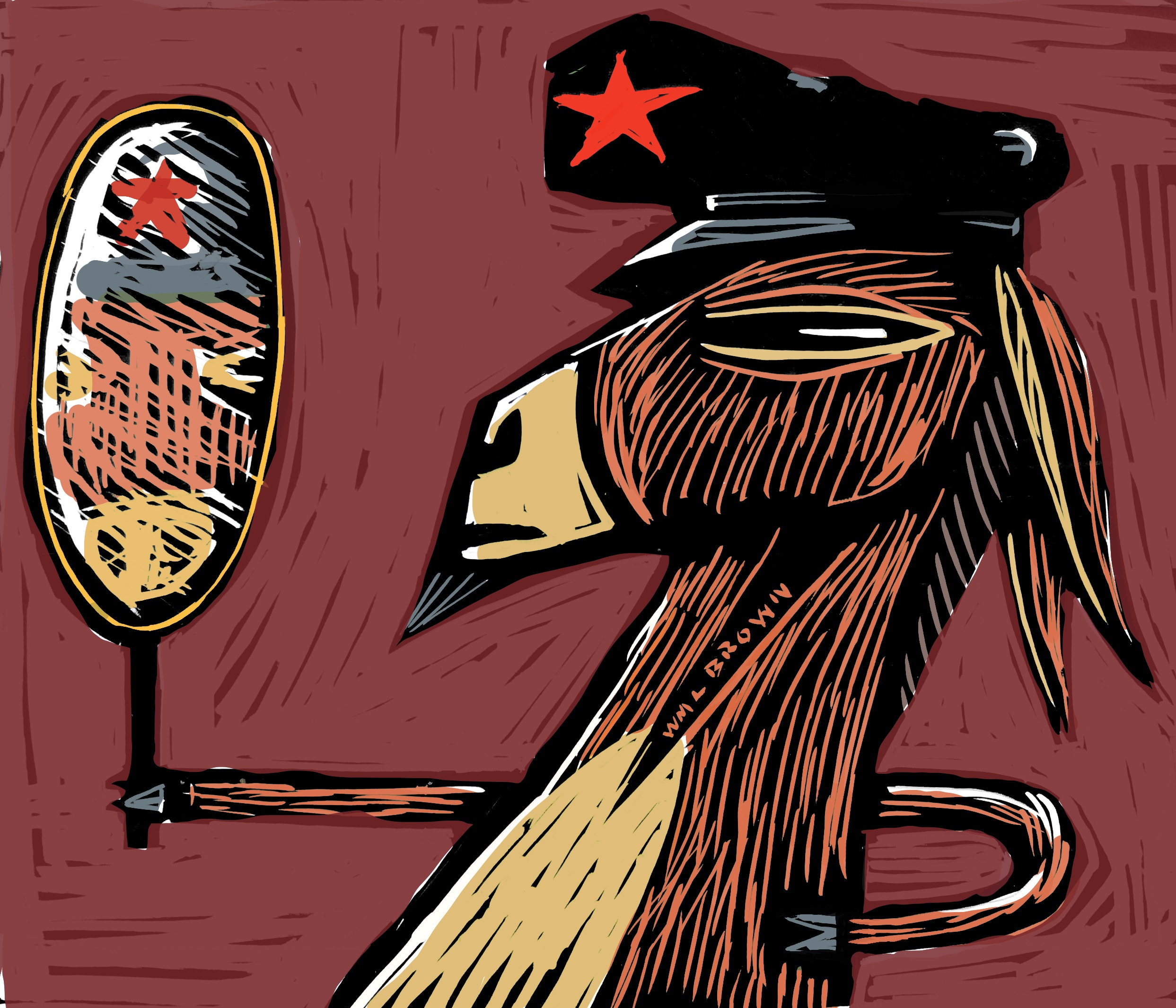
Democrats Consider Socialism, ©2017-2026 William L. Brown. “Does this make me look too tyrannical?”
Would you vote for a democratic fascist? Could you even stomach their presence? Would you listen if they assured you that those notoriously evil fascist countries were not really fascist. And if you’d studied fascism instead of only listening to propaganda, you’d know that fascism is a legitimate economic program that has never been properly implemented?
“Democratic socialism” is exactly the same. Progressives and social Democrats should stop using the term, not only because it demonstrates insensitivity to those who suffered under socialism, but because it makes them look, at best, naive, and at worst, dangerous.
Outside the small progressive bubble, most American voters understand the truth about socialism. Certainly all the Americans with roots in countries that suffered under it, and those who are too smart of be swayed by ideology, even if, like me, it takes a few years.
Just because the truth about socialism came from the right-wing, who framed it to suit their purposes, doesn’t make it untrue.
It’s a free country. Anyone can call themselves a socialist if they want. I hope those that do come to understand it makes them look insensitive and arrogant. I urge them to talk to people who lived under socialism, or seek out their accounts.

Hi Bill, Woody Woodruff here (a DSA member of 45 years' standing, including when we both worked at Publishers' Auxiliary). I would argue, in terms of who came first, that socialism and socialist parties *(see Eugene Debs, Jean Jaures, the Ehrfurt Programme etc.) were hard at work way before the creation of the USSR and its progeny. It is still a matter of belief among my comrades that the name and concept of socialism was semantically hijacked both by the USSR and the National Socialists.
Social democracy as practiced in many nations (including, as you say, marginally in the US as represented by public provision of schooling, parks etc.) has gradations from border to border but depends for its continuity on people getting what they expect for their taxes and seeing the books open for inspection.
A great deal of misery and oppression took place under the rubric of socialism, no question. It's a bitter history. But the idea of workers' control of public provision (and the control of the means of production to the extent needed for that end) is still working its way forward, even in the age of AI trillionaires.
Woody