
Bombing the Heart
Favorites in flame

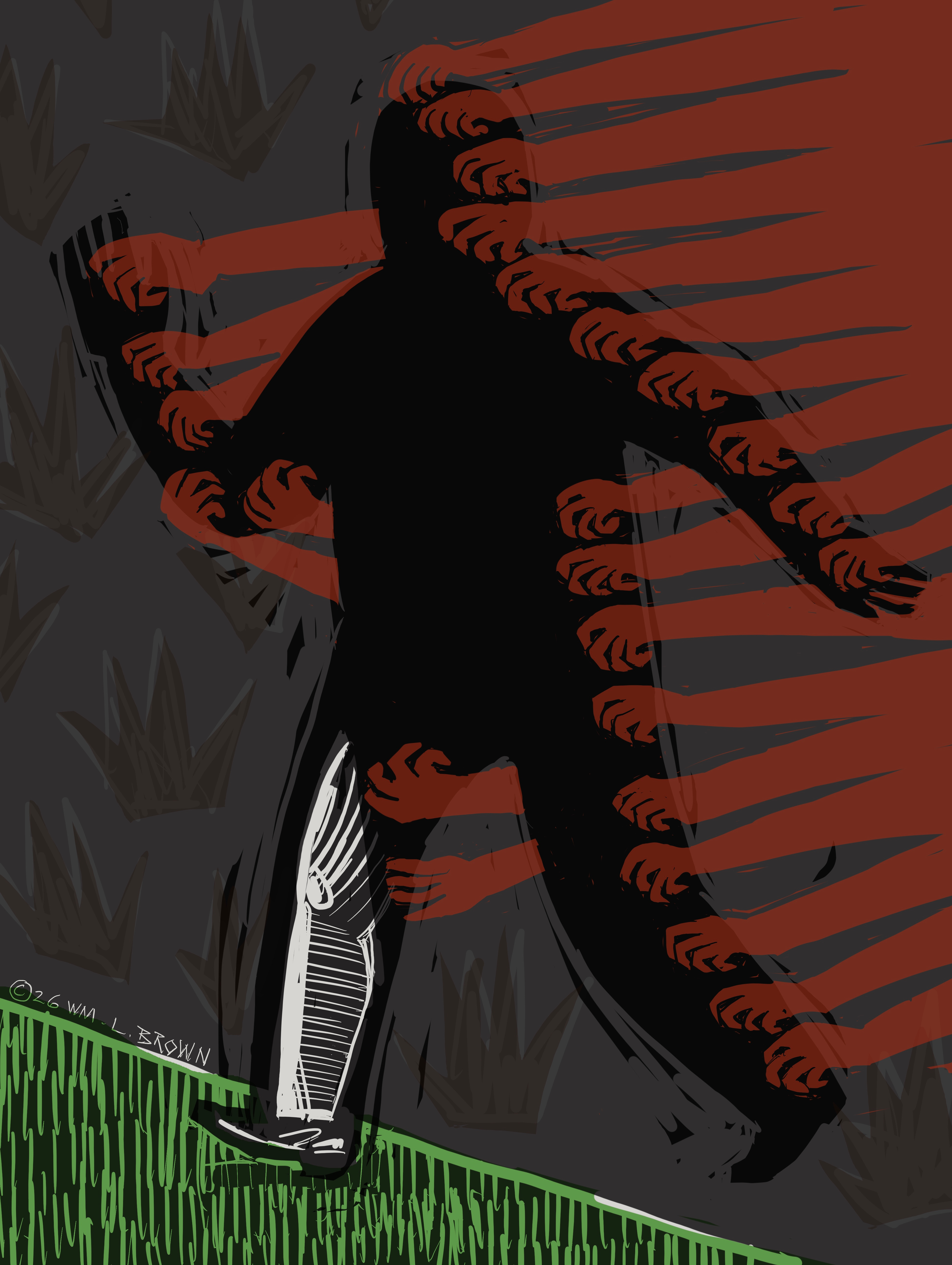
Emotional Drag, ©2026 William L. Brown. Dragged back by disturbing events into a state of a constant sense of urgency, yet struggling to respond through depressive heaviness.
Last week’s missile and drone attack on Kyiv, was upsetting. Russian missiles and drones hit historical and culturally beloved areas May 24, one of them my old neighborhood
It’s embarrassing that it affects me more than the May 14 attack in which 24 people died. In that barrage a missile collapsed a multi-story apartment house. The dead include three children. At least 48 people were injured. The May 24 casualties were fewer, but in terms of destruction in Kyiv it was the worst of the war so far.
Friend and sister-Substack-writer Larissa Babij had a similar reaction to the May 24 bombardment because of her affection for many of the sites damaged or destroyed. She describes walking to many of the sites the next day in her publication A Kind of Refugee.
The Russians struck my block in Podil, the historic neighborhood I lived in for most of 2020. That was at the start of the COVID pandemic during the most severe travel and social restrictions. So, my recreation, entertainment, and socializing consisted of walking around the neighborhood, admiring the buildings and streetscapes.
I couldn’t have asked for a prettier, more interesting location. The opera theater, official title: Kyiv Municipal Academic Opera and Ballet Theatre for Children and Youth, was two doors down, visible from my balcony. I often heard singers practicing, their voices joining a chorus with the swallows swooping over the opera house dome.. Across the street were buildings of the prestigious Kyiv-Mohyla Academy University: a church built around 1612 and the university library, which also suffered damage May 24.
In this video, you can see the opera house, the library tower is to the right. There are glimpses of the square and even colorful Saint Andrew’s church on top of the distant hill.


The opera and university face Kontraktova Ploscha (Contractors Square), the heart of Podil, Kyiv’s historic district, featuring a metro stop, a trolley-bus hub, scores of cafes, restaurants, coffee-shops, bars, art galleries, museums and ancient churches on, it seems, every corner, street musicians, food stands, A statue of Samson abusing a lion, electric cars driven by children, and a Ferris wheel strategically placed against a backdrop of quaint pastel-painted historical buildings. Every visitor to Kyiv has at least one photo of themself at the Ferris wheel scene.


Streets set diagonally to the city grid tend to be picturesque. There is one of these on the other side of the Opera building just off the square. It features an historic fire station with several bays for fire vehicles — originally horse-drawn. The fire-watch tower stands attentively.


The fire station now houses the Chornobyl Museum. When I lived a block away, there were Chornobyl emergency vehicles and excursion busses parked outside. It was the excursion bus departure point until the pandemic temporarily closed it down. The museum survived and expanded. The grand opening of the new, improved museum was held on the 30th anniversary of the Chornobyl disaster, April 26.
Less than a month later the museum contents were destroyed in the May 24 attack.
Facing the intersection of the diagonal street, and flanking the opera house, there is a fine Art Noveau apartment building, now damaged. This is the site of a new cafe, opened just the previous day. The owner rushed to the site following the attack and found everything damanged except the coffee machine. He started up the machine and through the smashed windows handed out free coffee to the emergency-response people swarming the area. Social media attention drew hundreds of people to queue up for coffee.


The worst damage occurred around the Lukianivska Metro. The long-standing neighborhood marketplace next to the metro entrance was charred to ashes. A more modern shopping mall on the other side is now a burnt, blackened shell.
Ukrainian market-places look much like western markets: fresh vegetables, dairy products, meat, honey and flowers sold by farmers, butchers, bee-keepers and small-time merchants, but unlike the west, the prices are lower than in supermarkets. The same for the adjacent bazaars selling household goods. Malls and supermarkets (except maybe the cut-rate supermarkets like ATB) are more expensive.


Here’s a report on the market venders’ resurgence.

Other Kyiv cultural landmarks, such as the National Art Museum, and the National Philharmonic of Ukraine were hit.


National Art Museum, photos taken 2021. The front entrance was not open at the time, so the photo features the side entrance, not the facade.


A particularly poignant and newly-relevant triptych at the National Art Gallery on display in 2021. Love. Family. Return, by Fedir Krychevski, 1925-1927, tempera on canvas.


Of course, it is not just the historic buildings or my memories that I’m worried about, it’s the people there, Larissa and all the other Ukraine-based writers I follow, friends, my students and their families, my colleagues at the agency I work for, and acquaintances such as the family who owns the Airb&b apartment I ended up renting for months due to the pandemic lockdown, the barista around the corner who was working on her linguistics Ph’D, and the friendly guy who sold apples at the market.
I fear for them, for their homes and businesses, and, yes, for the buildings, because those are the community framework. People need community, that’s why they create it. Destroying a community damages the souls of those in it.

Hey! Thank you for this post... I live in Podil now, and my house is just next street to the fire station / Chornobyl museum..... My heart is still recovering from this attack. Our building, our community, we are recovering, and there's lots of damage to buildings and windows. In truth, those attacks on Kyiv are getting worse, but the coverage in international media is not as strong as it used to be. War in Ukraine is no longer top news, but the russian terrorism is getting harsher towards those in the rear...
Thank you, Bill, for keeping us in your heart and on your Substack! It's true that russia is increasing the brazenness of its attacks on Ukrainian cities, and the fact that Ukrainians keep stubbornly living their lives while repeatedly clearing away the rubble and repairing their damaged apartments does not mean that we can live like this indefinitely.